Site overview

The Steenkoolmijn van Zwartberg was one of seven collieries in the Belgian Kempen coalfield, situated in the Zwartberg district of Genk in the province of Limburg. A concession of 4,180 hectares was granted on 25 October 1906 to the consortium Les Liègeois, led by the Luikse industrial group N.V. John Cockerill. The operating company S.A. pour l'Exploitation de la concession charbonnière des Liégeois en Campine was founded on 26 February 1907.

Shaft sinking began in 1913 but was severely delayed by the First World War; the first coal was reached in Schacht I on 27 February 1920, and full production began in 1925. Both shafts reached a depth of 1,045 metres with working levels at 654, 714, 780, 940, and 1,010 metres. In 1952 a firedamp explosion killed 23 miners.

By 1956 annual production reached 1,416,000 tonnes, its highest level. Peak employment stood at 5,355 workers in 1946. Total production reached approximately 39,902,000 tonnes.

The closure announcement in December 1965 provoked violent protests in which two people were killed. The mine closed on 1 October 1966. Both headframes were dynamited in 1967 and virtually all mine buildings were demolished.

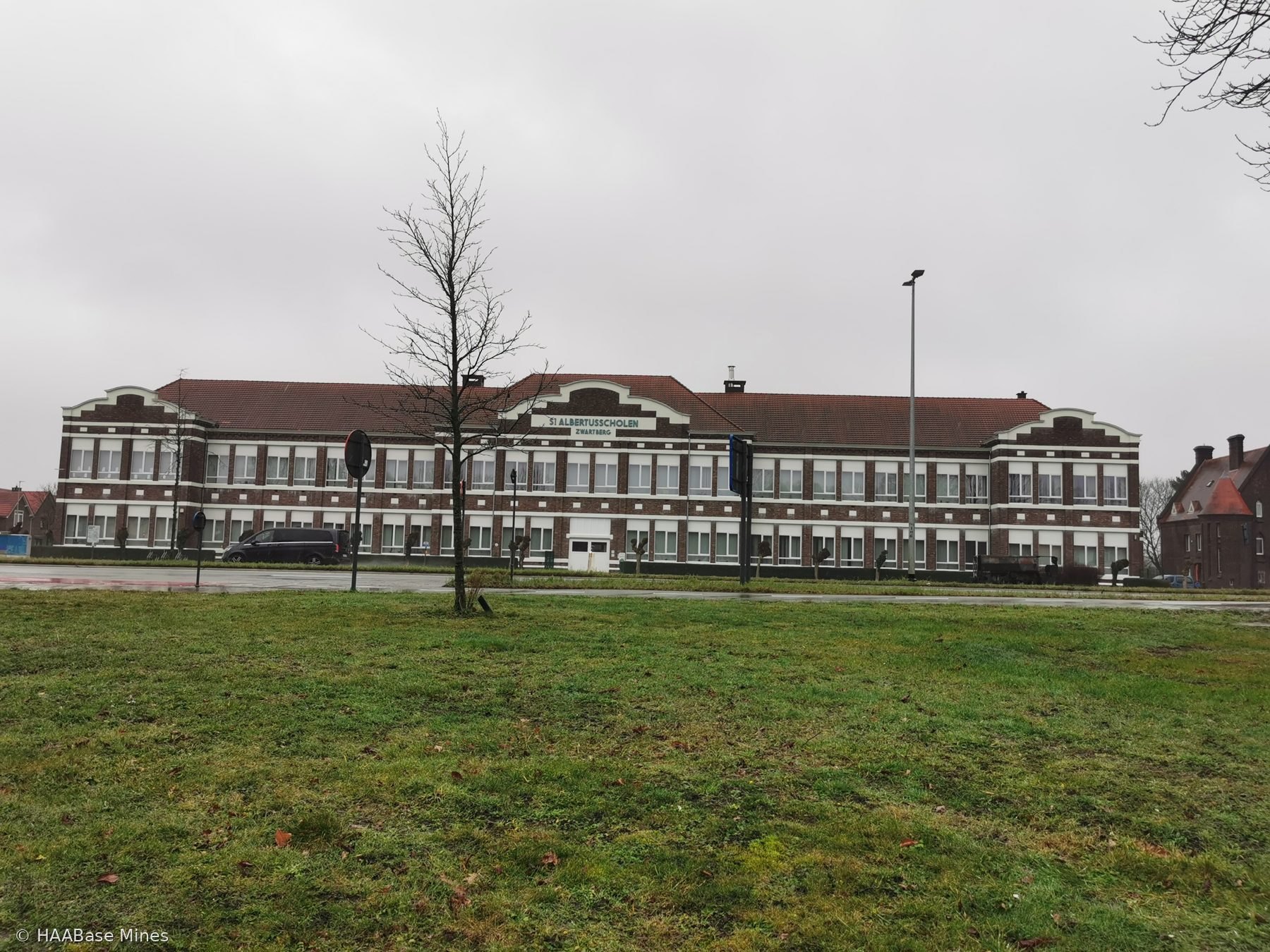
The director's villa was protected as a monument in 2005 and since 2019 forms part of the Labiomista art park.

The site is now largely absorbed into later urban surroundings, with little of the former colliery legible above ground and only scattered survivals marking the historic site.

Map & photo

Steenkoolmijn van Zwartberg mine headframe or winding tower site
Photograph taken: 21 February 2026
Map markers and directions links are provided for location reference only and do not indicate public access or permission to enter a site.

History

The Zwartberg coal mine owes its origins to the discovery of coal in the Belgian Kempen by André Dumont in 1901. In 1901 and 1902 three Luikse industrial groups — the N.V. John Cockerill, the coal mines Espérance et Bonne Fortune and Patience et Beaujonc — together with a consortium of local landowners including Théodore Masy, director of several Luikse mines, the industrialist Wittouck, and lieutenant-general Emile Thorn, filed applications for mining concessions under the heathland of the Kempen. By royal decree of 25 October 1906, a concession of 4,180 hectares was granted under Genk, Houthalen, Meeuwen, Gruitrode, Opglabbeek, Niel, and As, enlarged in 1910 to 4,269 hectares.

On 26 February 1907, the S.A. pour l'Exploitation de la concession charbonnière des Liégeois en Campine was founded with an initial capital of 12,500,000 francs divided into 25,000 shares. The first 5,000 shares remained with the founding groups; the remaining 20,000 were subscribed by seventeen shareholders. The principal shareholders were the Mutualité Industrielle, the S.A. John Cockerill, and the coal mines Espérance et Bonne Fortune and Patience et Beaujonc. After successive capital increases, the mine became a division of the S.A. John Cockerill in 1929, and via this company was incorporated into the industrial group Cockerill-Ougrée on 27 June 1955.

Depth soundings were conducted to determine the mine location, reaching as far as 1,162 metres. It was decided to establish the first exploitation seat at Zwartberg, with a second — never realised — working to come later in the northern part of the concession. In 1910 the first buildings were inaugurated including the power station, and a railway connection to the Hasselt-Maaseik line was established. Freezing borings and shaft sinking were carried out from 1913 by the Gewerkschaft Deutsche Kaiser. When the First World War broke out, Schacht I had reached only 193 metres; by 1918 a depth of 480 metres had been achieved. The first coal formations in Schacht I were reached without incident on 27 February 1920 at a depth of 575 metres. Shaft sinking for Schacht II was delayed by a water breakthrough at 318 metres, but on 2 November 1924 the coal measures were also reached in that shaft at 556.20 metres.

Initial exploitation took place between 690 and 840 metres. From 1938, after the shafts had been deepened to 1,050 metres, the working level between 840 and 1,010 metres was brought into use. Both shafts had a useful diameter of 5.25 metres and were lined with cast-iron rings to a depth of 578 metres, with masonry below that and concrete blocks at the lowest section. Schacht I's headframe stood 83.5 metres tall, making it the second tallest in Europe at the time. Full production commenced in 1925. The fat coal extracted was used primarily in the Cockerill blast furnaces at Seraing.

The first workers' housing, the Cité Cockerill of 36 houses, was built in As in 1912 for the workers sinking the shafts, as the concession consortium initially expected the first mine to be sited in As. The main cité for workers and staff — known as the Noorderwijk — was developed immediately adjacent to the mine site from the 1910s, modelled on the Seraing garden suburb. It was divided between a residential zone for office staff around the Cockerillplaats and an opposite workers' quarter centred on the Delcourtplaats.

In 1949, the first air cooling installation in Europe was fitted underground at Zwartberg, where working temperatures reached a constant 44 degrees Celsius. The mine also introduced an internal closed-circuit television system in the 1950s to improve safety. These innovations made Zwartberg known as the most modern and best-equipped mine in Belgium.

Peak employment of 5,355 workers was recorded in 1946. In 1952, a firedamp explosion killed 23 miners. Peak annual production of 1,416,000 tonnes was achieved in 1956. Total production over the mine's life amounted to 39,902,000 tonnes.

On 22 December 1965, the Belgian government announced the closure of Zwartberg together with five Walloon mines. The decision shocked the region: Zwartberg was at that moment the most modern and productive mine in Belgium. Workers occupied the underground shafts from 27 January 1966. During a march from Zwartberg to the Waterschei colliery on 31 January 1966, the mobile gendarmerie opened fire on the demonstrators; Jan Latos, a 27-year-old miner, was shot dead, and Valère Sclep, a 26-year-old worker, died from a tear-gas canister. On 2 February 1966 the Akkoorden van Zwartberg were signed, providing for the orderly redeployment of the approximately 4,500 workers and committing other Kempen mines to absorb the displaced underground workers before recruiting guest workers. The mine closed on 1 October 1966.

Demolition was immediate. In 1967 the two steel headframes were dynamited and virtually all mine buildings were razed. The shafts were capped with concrete slabs. One spoil heap was preserved; the other was exploited over the years and levelled. Remnants of the mine wall and a small technical services building survived on the current industrial estate. The 1959 administrative building has served since closure as a police and emergency services training centre, the PLOT. The director's villa and its twelve-hectare park were sold in 1967 to the Wauters family, who operated a zoo on the grounds for thirty years. After the zoo closed, the city of Genk acquired the property. In 2005 the director's villa was listed as a protected monument and restoration works were supported in 2011. Since 2019 the villa and its grounds form part of Labiomista, an art centre and Cosmopolitan Culture Park created by artist Koen Vanmechelen. A memorial marker, incorporating a sheave wheel, was placed over the concrete slab sealing Schacht II on the current industrial estate.
Timeline

1901–1902
Exploration

Survey borings filed for Kempen concessions

In 1901 and 1902 three Luikse industrial groups including N.V. John Cockerill, together with local landowners, filed concession applications under the Kempen heathland.
1906
Legislation

Concession Les Liègeois en Campine granted

A concession of 4,180 hectares was granted by royal decree on 25 October 1906 to the Les Liègeois consortium under Genk, Houthalen, Meeuwen, Gruitrode, Opglabbeek, Niel, and As. It was enlarged to 4,269 hectares in 1910.
1907
Legislation

S.A. pour l'Exploitation de la concession charbonnière des Liégeois en Campine founded

The operating company was founded on 26 February 1907 with an initial capital of 12,500,000 francs. Principal shareholders included the S.A. John Cockerill, the Mutualité Industrielle, and the coal mines Espérance et Bonne Fortune and Patience et Beaujonc.
1910
Construction

First buildings inaugurated; railway connection established

In 1910 the first mine buildings were inaugurated including the power station, and a railway connection to the Hasselt-Maaseik line was established to serve the colliery.
1913
Construction

Shaft sinking commenced by Gewerkschaft Deutsche Kaiser

Freezing borings and shaft sinking for both shafts were carried out from 1913 by the Gewerkschaft Deutsche Kaiser. When the First World War broke out, Schacht I had reached only 193 metres depth.
1920
Exploration

Coal seam reached in Schacht I

The first coal formations in Schacht I were reached without incident on 27 February 1920 at a depth of 575 metres, after years of delay caused by the First World War.
1924
Exploration

Coal seam reached in Schacht II

On 2 November 1924, after a water breakthrough at 318 metres had delayed progress, the coal measures were reached in Schacht II at a depth of 556.20 metres.
1925
Operation

Full production commences

Production came fully on stream in 1925. Both shafts reached a depth of 1,045 metres, with working levels established at 654, 714, 780, 940, and 1,010 metres. Fat coal was produced for the Cockerill blast furnaces at Seraing.
1929
Operation

Mine absorbed into S.A. John Cockerill group

After successive capital increases, the mine became a division of the S.A. John Cockerill in 1929.
1938
Construction

Shafts deepened to 1,050 metres; lower working level opened

After deepening of both shafts to 1,050 metres, the working level between 840 and 1,010 metres was brought into use from 1938.
1946
Operation

Peak employment of 5,355 workers

Peak employment of 5,355 workers was recorded in 1946.
1949
Construction

First underground air cooler in Europe installed

In 1949 the first underground air cooler in Europe was installed at Zwartberg, where permanent working temperatures reached 44 degrees Celsius.
1952
Operation

Firedamp explosion kills 23 miners

A firedamp explosion in 1952 killed 23 miners at the colliery.
1955
Operation

Incorporated into Cockerill-Ougrée industrial group

Via the S.A. John Cockerill, the mine was incorporated into the Cockerill-Ougrée industrial group on 27 June 1955.
1956
Operation

Peak annual production of 1,416,000 tonnes

Annual production reached its maximum of 1,416,000 tonnes in 1956.
1965
Closure

Belgian government announces closure

On 22 December 1965 the Belgian government announced the closure of Zwartberg together with five Walloon mines. The decision shocked workers and the region: Zwartberg was at that point the most modern and productive mine in Belgium.
1966
Closure

Workers occupy underground shafts; protest demonstrations

From 27 January 1966 workers occupied the underground shafts. During demonstrations on 31 January 1966, the gendarmerie opened fire; Jan Latos, a 27-year-old miner, was shot dead, and Valère Sclep, a 26-year-old worker, died from a tear-gas canister impact.
1966
Closure

Akkoorden van Zwartberg signed

On 2 February 1966 the Akkoorden van Zwartberg were signed, providing for orderly redeployment of the approximately 4,500 workers and committing other Kempen mines to absorb the displaced workforce before recruiting new guest workers.
1966
Closure

Final closure

The Steenkoolmijn van Zwartberg closed on 1 October 1966, the first of the seven Kempen mines to close. Total production over the mine's life reached approximately 39,902,000 tonnes.
1967
Closure

Both headframes dynamited; virtually all buildings demolished

In 1967, immediately after closure, the two steel headframes were dynamited and virtually all mine buildings were demolished. The shafts were capped with concrete slabs.
2005
Heritage

Director's villa listed as a protected monument

The director's villa and its twelve-hectare park were protected as a monument in 2005. Restoration works received a subsidy of €350,000 from the Flemish minister in 2011.
2019
Redevelopment

Director's villa becomes part of Labiomista

Since 2019 the former director's villa and its grounds form part of Labiomista, a 24-hectare art centre and Cosmopolitan Culture Park created by artist Koen Vanmechelen on the former zoo site adjacent to the former colliery.

Sources and records

Dutch Wikipedia article: Steenkoolmijn van Zwartberg
Inventaris Onroerend Erfgoed record: Steenkoolmijn van Zwartberg (erfgoedobjecten/122124)
Belgischesteenkoolmijnen.be: Zwartberg
Koolmijnen.be: Zwartberg
Industriecultuur.be: Mijn van Zwartberg
Cosimo.be / Ons Mijnverleden: 50 jaar geleden ging mijn van Zwartberg dicht; Koolmijn Zwartberg
Fabriekofiel.com: Genk
Solidair.org: 50 jaar geleden ging mijn van Zwartberg dicht
Visit Limburg: Zwartberg colliery
De Lage Landen: C-mine Expeditie article
This researched site record is part of the HAABase Mines database. Normal personal research and browsing is welcome. Automated bulk extraction, republication, or harvesting of site text and images is not permitted without written consent.