Site overview

Botallack Mine, set on the clifftops of the Tin Coast between St Just and Pendeen in west Cornwall, is one of the most celebrated former mines in England. Archaeological evidence suggests mining activity in the Roman period around AD 200, and records confirm working from the sixteenth century. The mine reached its productive height in the mid-nineteenth century under Stephen Harvey James, employing over 550 people; over its recorded lifetime it produced approximately 14,500 tonnes of tin, 20,000 tonnes of copper, and 1,500 tonnes of arsenic, along with an estimated 1.5 million tonnes of waste.

The distinctive Crowns engine houses, clinging to the cliff face above the Atlantic, were built in the nineteenth century. The Boscawen diagonal shaft was begun in 1858 and descended at 32.5 degrees for approximately 2,616 feet into the seabed. The mine closed in 1895 due to falling tin and copper prices.

A second working period from 1908 to 1914 produced Allen's Shaft. The National Trust acquired the site in 1997. The Crowns engine houses are Grade II listed.

Since 2006 Botallack has formed part of the Cornwall and West Devon Mining Landscape UNESCO World Heritage Site.

The mine occupies an exposed clifftop setting above the Atlantic, where the surviving engine houses and mine remains are visually dramatic and read as isolated structures against the coastal landscape.

Map & photo

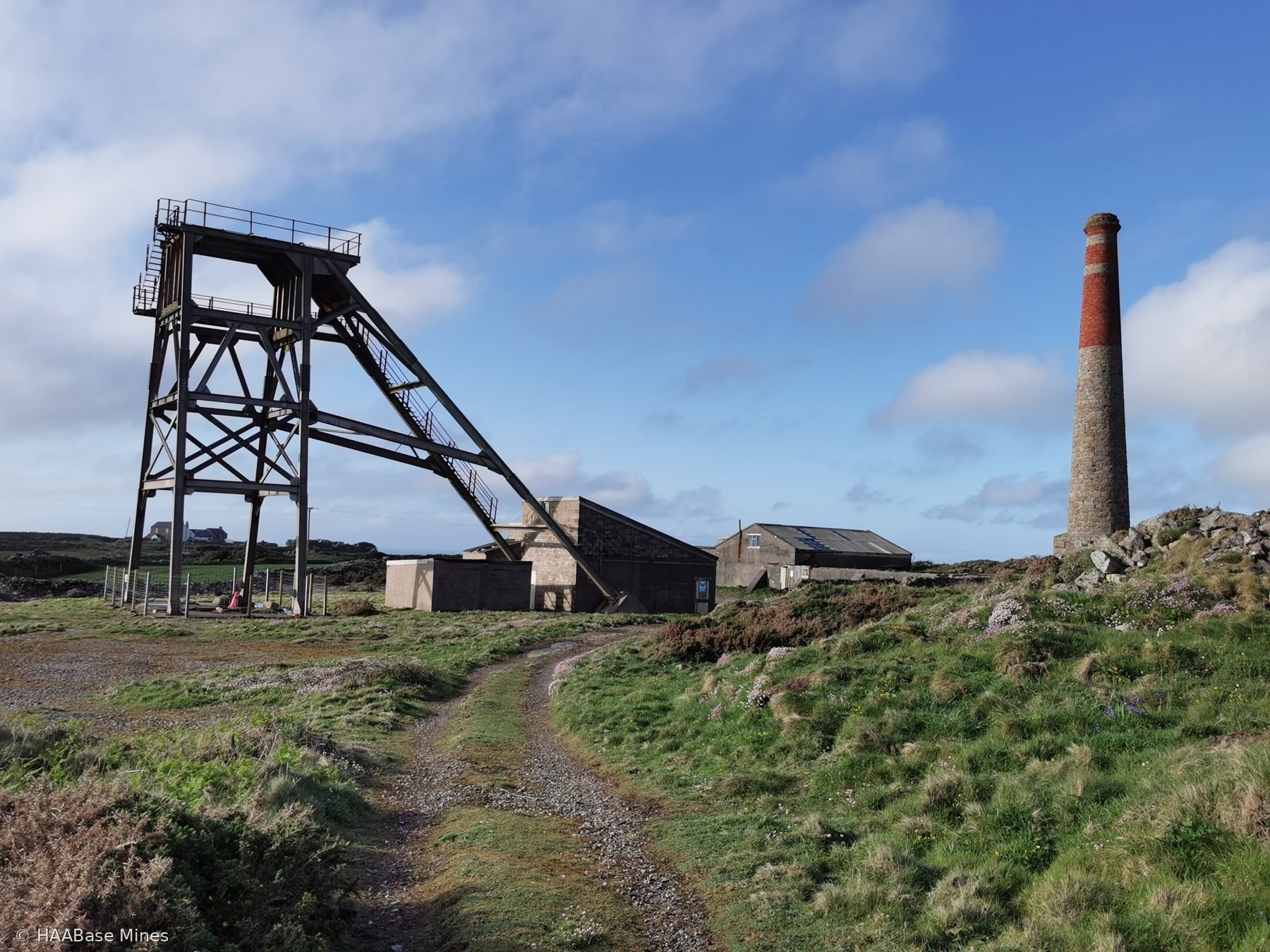
Botallack Mine mine headframe or winding tower site
Photograph taken: 17 May 2022
Map markers and directions links are provided for location reference only and do not indicate public access or permission to enter a site.

History

Mineralogical and archaeological evidence suggests that Botallack was worked in the mid-Roman period around AD 200, with possible earlier Bronze Age activity. Records confirm mining in the sixteenth century, when shafts were kept simple and shallow to avoid draining seawater. By 1774 improved pump technology had been overcome sufficiently for men to work under the sea at Tolvan shaft. Nicholas Boynes was captain of the mine in the early eighteenth century and opened a deep adit level, driven to the Corpus Christi lode in the higher mine. The first steam engine at Carnyorth Moor, later part of the Botallack sett, was put to work in either 1795 or around 1810, depending on the source.

The Crowns engine houses, built of Cornish granite and brick and set low on the cliff face above the Atlantic, date from the nineteenth century. The lower building held the engine which pumped water from the shaft below; the upper contained a winding engine for men and materials. The Cornwall Guide source dates the Crowns engine houses to 1815. The Count House was completed in 1861, built from local granite to house mine administration, the purser, mine captain, and surveyors, and was deliberately grander in style than local buildings to promote shareholder confidence.

In 1835 the mine was put up for sale. Stephen Harvey James (1795–1870), a local former Cornish wrestler, bought it and sustained it at a loss through a difficult period. In 1841, with shareholders voting to end their losses and James given two months to turn the business around, a large lode of copper was discovered which yielded a £44,000 profit, salvaging both James and the mine's fortunes. The abolition of tin duty in 1838 had helped the mine continue despite tin prices falling to £45 per ton. Under James's ownership tin production reached its height, with over 550 people on site including 340 men underground.

In 1858 the Boscawen diagonal shaft was begun, sunk at an angle of 32.5 degrees to a total distance of approximately 2,616 feet, reaching a final depth of 1,360 feet below sea level, with the mine's workings extending 2,580 feet under the sea. The upper engine house for the Boscawen diagonal shaft was built around 1862 to provide winding power. This shaft attracted distinguished visitors: the Prince of Wales (the future King Edward VII) and Princess Alexandra descended it on 24 July 1865, prompting a tourist boom. The mine began charging visitors a guinea per person for tours, with proceeds going to a relief fund for widows and injured miners. An accident in 1863 caused by a gig chain breaking had killed eight miners and a boy.

The principal shafts of the mine included: Botallack skip-shaft (205 fathoms), Boscawen diagonal shaft (approximately 500 fathoms long, perpendicular depth 240 fathoms and extending 300 fathoms under the sea), Bullion skip-shaft (185 fathoms), Pearce's skip-shaft (130 fathoms), and approximately ten other shafts of varying depths. In the later period the average monthly yield was approximately 19 tons of tin, 3 tons of copper, and 4 tons of arsenic, with 265 workers employed and a wage bill of approximately £800 per month.

Increasing supply of tin from Malaysia, Banka Island, Sumatra, and from the 1870s onwards from Australia, together with falling demand for tinplate in the American market, drove down prices. The arsenic works at Botallack produced refined arsenic from tin ore roasted in a calciner, with arsenic gas drawn through snaking labyrinthine condensing chambers before collection. Over its recorded lifetime the mine produced approximately 14,500 tonnes of tin, 20,000 tonnes of copper, and 1,500 tonnes of arsenic. By 1895 the combination of low tin prices and the high cost of keeping the shafts clear of seawater forced the mine's first closure.

Between 1908 and 1912 Allen's Shaft was sunk as part of a new attempt to work the mine. This project involved a large steam hoist, a big compressor, and a neighbouring electric power station with terrazzo flooring. With the approach of the First World War, Botallack closed for a second time in March 1914. In the 1980s Geevor Tin Mines attempted to reopen Botallack workings, but the Great Tin Crash of 1985 caused global tin prices to fall by a third in a week, ending that prospect.

The Carn Brea Mining Society repaired the Crowns engine houses in 1985. The National Trust acquired Botallack Mine and the Crowns in 1997. The Crowns engine houses are Grade II listed buildings. In 2006 Botallack was inscribed within the Cornwall and West Devon Mining Landscape UNESCO World Heritage Site. The mine also falls within the Aire Point to Carrick Du Site of Special Scientific Interest and the South West Coast Path passes along the cliff. A National Trust café and small museum operate from the former Count House stables. The site's mineral wealth included, beyond tin, copper, and arsenic, also cobalt, lead, iron, silver, and botallackite, a rare copper mineral first identified at this site.
Timeline

Exploration

Roman and prehistoric mineral working at the site

Archaeological evidence suggests Botallack was worked for minerals in the mid-Roman period around AD 200, with possible Bronze Age activity also indicated. Records confirm shallow mining in the sixteenth century.
Construction

First steam engine installed at Carnyorth Moor

The first steam engine at Carnyorth Moor, later part of the Botallack sett, was put to work in either 1795 or around 1810, depending on the source.
1774
Construction

Men working under the sea at Tolvan shaft

By 1774 improved pump technology had enabled men to work under the sea at Tolvan shaft.
1835
Legislation

Stephen Harvey James acquires the mine

In 1835 Botallack Mine was put up for sale. Stephen Harvey James (1795–1870), a local former Cornish wrestler, bought it and sustained it at a loss through falling tin prices.
1838
Legislation

Abolition of tin duty aids the mine's continuation

The abolition of tin duty of 4 shillings per 120 lbs to the Duke of Cornwall in 1838 helped keep the mine operating despite a fall in tin prices to £45 per ton.
1841
Exploration

Large copper lode discovered; mine's fortunes rescued

In 1841, with shareholders voting to end their losses, a large lode of copper was discovered yielding a £44,000 profit, rescuing both Stephen Harvey James and the mine.
1858
Construction

Boscawen diagonal shaft begun

The Boscawen diagonal shaft was begun in 1858, descending at 32.5 degrees to a total distance of approximately 2,616 feet, reaching a perpendicular depth of 1,360 feet below sea level, with workings extending 2,580 feet under the sea.
1861
Construction

Count House completed

The Count House was completed in 1861, built from local granite to house mine administration. It was deliberately grander in style than local buildings to promote confidence among shareholders.
1862
Construction

Upper Crowns engine house built for Boscawen shaft winding

The upper Crowns engine house was built around 1862 to provide winding power for the Boscawen diagonal shaft.
1865
Heritage

Royal visit: Prince and Princess of Wales descend Boscawen shaft

On 24 July 1865 the Prince of Wales (the future King Edward VII) and Princess Alexandra descended the Boscawen diagonal shaft. The visit sparked a tourist boom; the mine began charging a guinea per person for tours, with proceeds going to a widows and injured miners' relief fund.
1895
Closure

First closure due to falling tin and copper prices

By 1895 the combination of low tin and copper prices and the high cost of keeping shafts clear of seawater forced the closure of Botallack Mine.
1908–1914
Construction

Allen's Shaft sunk; second working period

Between 1908 and 1912 Allen's Shaft was sunk, along with a large steam hoist, compressor, and electric power station. The mine closed for a second time in March 1914 as the First World War approached.
1985
Heritage

Crowns engine houses repaired by Carn Brea Mining Society

The Carn Brea Mining Society repaired the Crowns engine houses in 1985, following a period in which the local community worked to preserve the Tin Coast mining sites.
1997
Heritage

National Trust acquires Botallack Mine and the Crowns

The National Trust acquired Botallack Mine and the Crowns in 1997. The Crowns engine houses are Grade II listed buildings.
2006
Heritage

Inscribed within Cornwall and West Devon Mining Landscape UNESCO World Heritage Site

In July 2006 Botallack was inscribed as part of the Cornwall and West Devon Mining Landscape UNESCO World Heritage Site.

Sources and records

Wikipedia article: Botallack Mine
National Trust website: History of Botallack and Things to see and do at Botallack
cornwalls.co.uk Cornwall Guide: Botallack Mine
photofilecornwall.co.uk: Botallack Mine and the Crowns
britainexpress.com: Botallack Mine and Crown Engine Houses
Ancient Origins article: Botallack Mine
Historic England listing: Crowns engine houses (Grade II)
Tripadvisor visitor review referencing Count House history
This researched site record is part of the HAABase Mines database. Normal personal research and browsing is welcome. Automated bulk extraction, republication, or harvesting of site text and images is not permitted without written consent.