1821
Reconnaissance boring authorised
A reconnaissance sounding was authorised in 1821 on the territory that would become the Rosières-Varangéville concession.
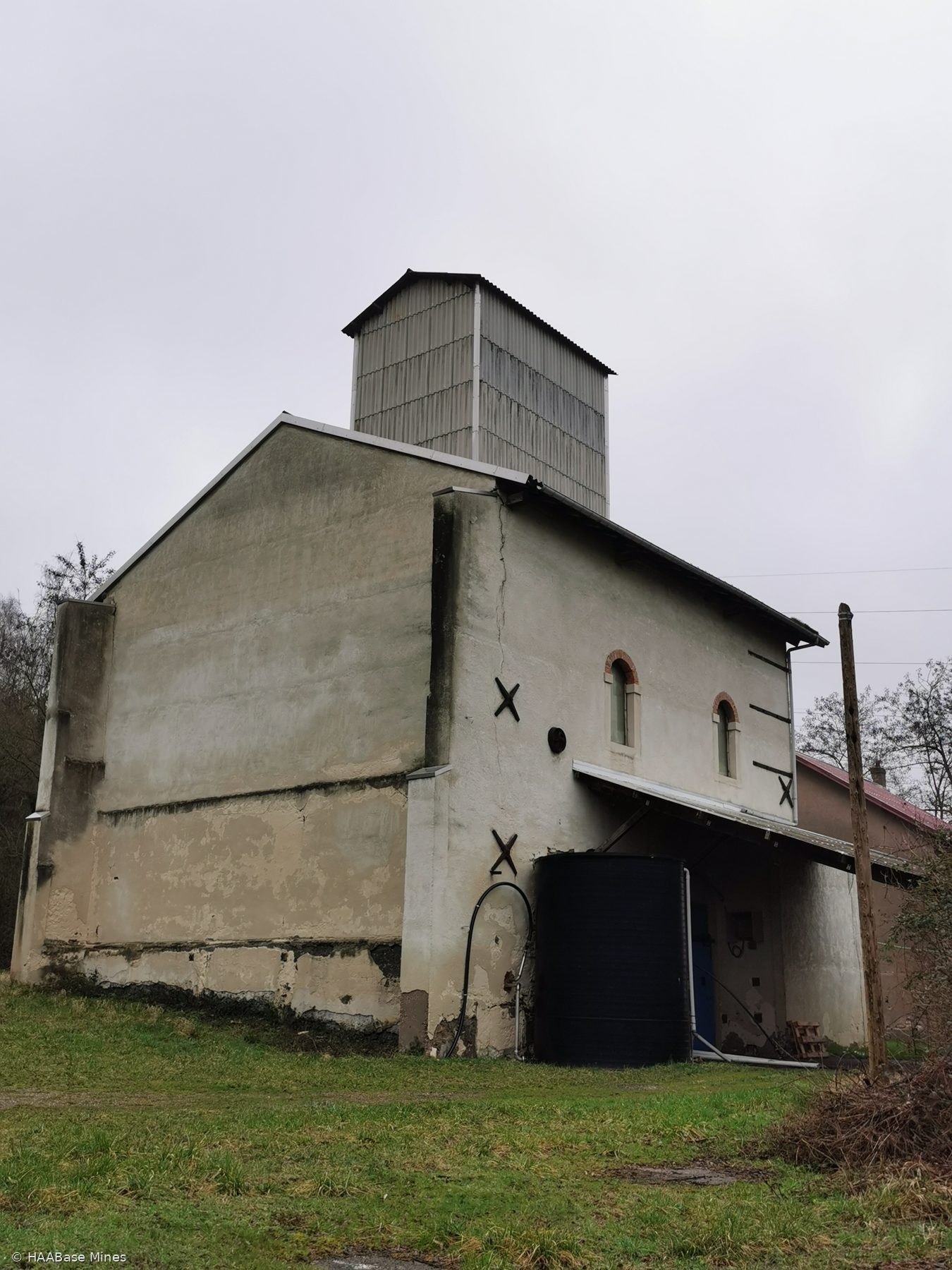
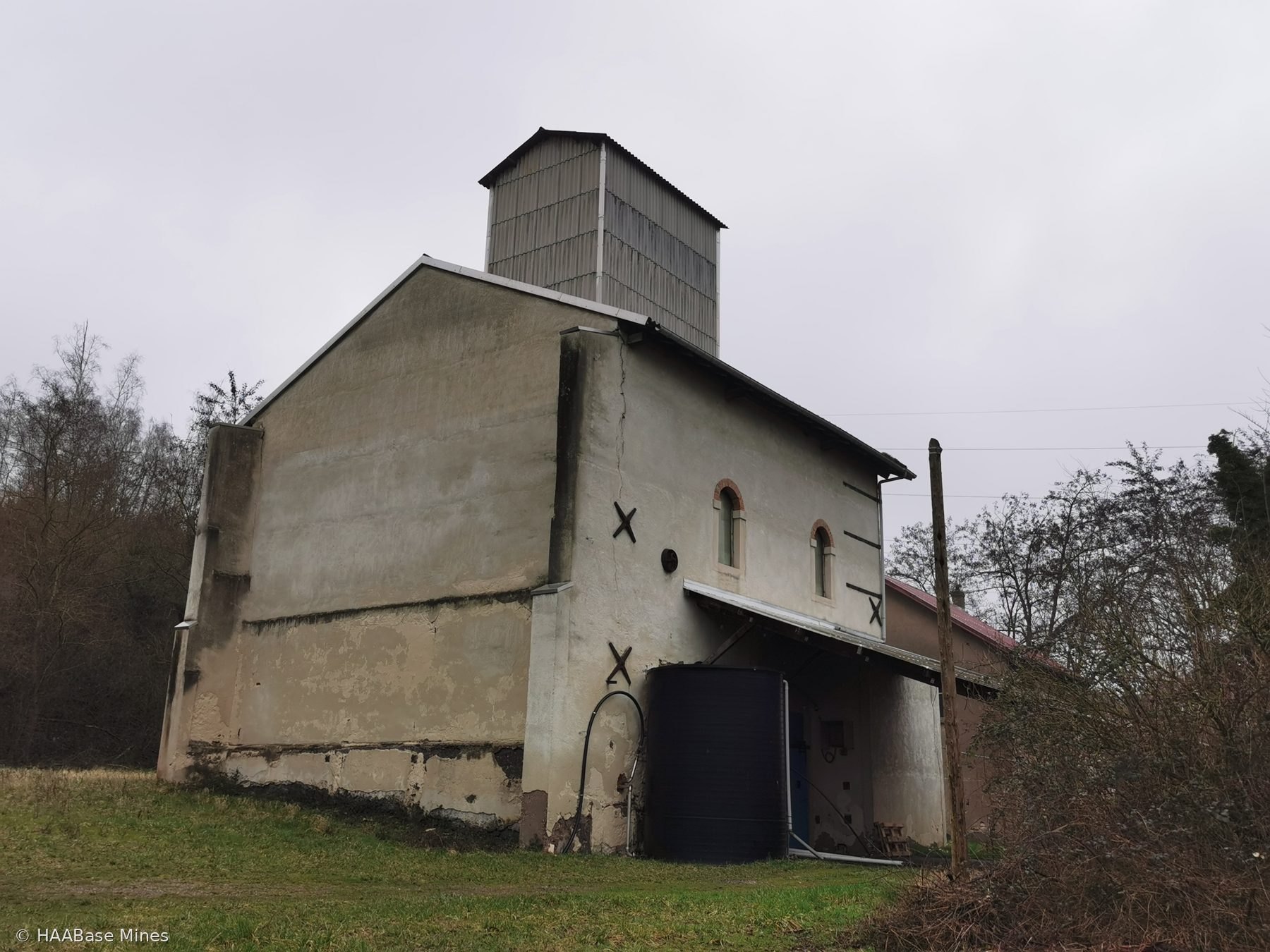
Former rock-salt mine on the Rosières-Varangéville concession, now integrated into the active Saint-Nicolas mine workings and serving as a return-air shaft.
The Mine de sel de Varangéville (2), operating on the concession of Rosières-Varangéville, is a former rock-salt mine at Varangéville in the Meurthe-et-Moselle, now integrated underground with the active Saint-Nicolas mine. The Rosières-Varangéville concession, the oldest salt concession in the Meurthe-et-Moselle at 848 hectares, was granted by royal ordinance on 7 June 1845 to a civil society, later becoming the Société des Mines et Salines de Rosières-Varangéville. Its principal shaft, the puits RV (Rosières-Varangéville), was sunk from 1855 and entered service in 1858 at 125 metres depth.
It was used for the extraction of rock salt by the method of abandoned pillars and chambers. After 1868 the operating company became known as the Saline Maugras under the direction of Monsieur Maugras. The associated saline produced 6,000 quintaux of refined salt per year by 1900.
The mine and saline were progressively centralised and the saline ceased definitive activity in 1964–65 following absorption into the wider Varangéville enterprise. The puits RV was retained as a second ventilation and security shaft for the Saint-Nicolas mine and its underground galleries were connected to those of the Saint-Nicolas workings. The Rosières-Varangéville concession was renounced on 31 December 2018.
The Rosières-Varangéville concession, the oldest mining concession in the Meurthe-et-Moselle, was initially granted by royal ordinance on 7 June 1845 to a civil society which had already carried out borings at Varangéville. An additional grant followed on 24 December 1852, defining the concession limits over the territories of Dombasle, Rosières-aux-Salines, Saint-Nicolas-de-Port and Varangéville for a duration of 99 years, covering a total area of 848 hectares. The society became the Société des Mines et Salines de Rosières-Varangéville. Further concessions were added on 1 September 1855 and 17 February 1881.
A reconnaissance boring was authorised in 1821. The principal shaft of the mine, the puits RV (Rosières-Varangéville), was sunk from 1855 with a wooden lining, traversing 118 metres of calcareous and argillo-gypseous Keuper terrain before reaching the salt deposit. The shaft entered service in 1858 at 125 metres depth and was used for the extraction of rock salt by the abandoned-pillar method in chambers 10 to 15 metres wide and 4.5 metres high. The mineral sondages on this concession were supplemented by a further shaft known as puits de secours, sunk between 1856 and 1905. Sondage boreholes on the concession were connected to the associated saline by a 125-mm diameter brine pipeline of 2 kilometres length.
In 1868 the administrative direction of the company passed to Monsieur Maugras, and the operation subsequently took the name Saline Maugras. From 1872 a second shaft, also referred to in sources as the puits RV foncé en 1872, was sunk to 125 metres depth as a further extraction shaft. By 1908, 150 miners had extracted 100,000 tonnes of salt from a working area of 20 hectares. By 1900 the saline was producing 6,000 quintaux of refined salt per year from 5,000 square metres of evaporating pan surface.
In 1891 the Saline Maugras accommodated the Soudière de la Meurthe within its perimeter, with much of the brine used for soda manufacture. In 1912 an administrative order prohibited water injection in the two principal sondages following risks of surface subsidence. In 1923 the operation was absorbed by the Manufactures des Glaces et Produits Chimiques de Saint-Gobain, Chauny et Cirey.
The saline underwent progressive closure as a result of the centralisation policy of the Lorraine salt industry. In 1942 the saline was temporarily closed. In 1948 a new operating company, the S.A. d'Exploitation des Mines de Sel et Salines de Varangéville (S.E.V.), was established. In 1950 the saline was provisionally closed again. In 1960 a fusion was made with the Saint-Nicolas mine at Varangéville. In 1964 the saline ceased definitive activity. The concession, which had been for 99 years from 1845, was renounced on 31 December 2018.
The puits RV was retained after the closure of the Rosières-Varangéville mine as a ventilation and security shaft for the adjacent Saint-Nicolas mine (site 184), following the underground connection of the two mine workings. It continues to function as the return-air shaft (puits de retour d'air) of the Saint-Nicolas mine. The winding machine on the puits RV is a flat-cable drum-type machine. The shaft is the most distant of the three shafts currently associated with the Varangéville mine complex.