History
The Compagnie des mines de Lens operated up to sixteen pit heads before the First World War. The fosse n° 13 dite Saint-Élie was sunk from 10 July 1902 and entered extraction on 13 November 1908, located at Hulluch. A dedicated upcast shaft, the puits n° 13 bis, was begun on 11 September 1909 at a separate surface site at Bénifontaine, to provide ventilation for the fosse n° 13.
The puits n° 13 bis was 331 metres deep and 4.80 metres in diameter; it entered service in 1910. A flat spoil heap, terril n° 67, was built on the northern part of the surface site using material removed during sinking. Three pairs of workers' houses were constructed near the pit head.
When German forces entered Lens on 4 October 1914, mining operations across the company's collieries ceased entirely. Following the liberation of the fosse n° 15 by British forces, German troops systematically destroyed surface installations and shaft linings across the Lens coalfield, flooding the underground workings and dynamiting the shafts, excepting only the n° 15 and 16 bis. The fosse n° 13 bis was destroyed in this process.
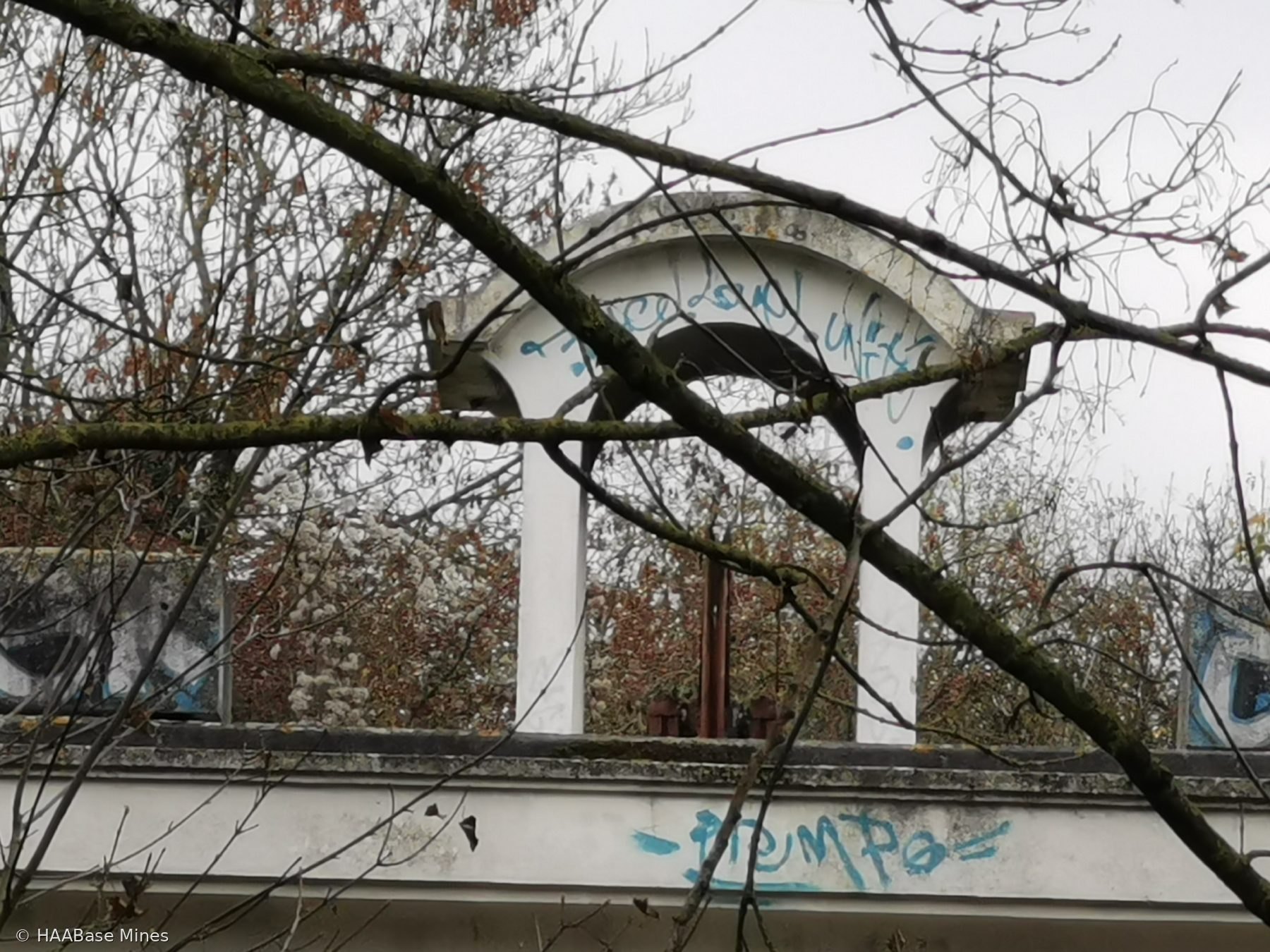
After the war, the Compagnie des mines de Lens undertook extensive reconstruction work. The fosse n° 13 bis was entirely rebuilt in 1920, receiving a new reinforced-concrete headframe of an atypical design: it is fitted with a single sheave wheel and is surmounted by a campanile, also in reinforced concrete, integrated within a building combining concrete structure and brick infill. This headframe is distinguished from others of the company by its unique style and very modest dimensions.
The Compagnie des mines de Lens was nationalised in 1946 and integrated into the Groupe de Lens. In 1952 the Groupe de Lens merged with the Groupe de Liévin to form the Groupe de Lens-Liévin. From 1954, the puits n° 13 bis provided return-air ventilation for the fosse n° 18 – 18 bis, sited at Hulluch, 1,476 metres to the north-west.
The puits n° 13 bis, 331 metres deep, was backfilled in 1958. At the beginning of the twenty-first century, Charbonnages de France materialised the pit-head marker. The BRGM conducts annual inspections.
The pit-head installations were acquired by the commune of Bénifontaine in 1992. The headframe and its associated building, in their entirety, were inscribed as a monument historique on 23 October 2009. On 30 June 2012, the installation was included among the 353 elements across 109 sites inscribed on the UNESCO World Heritage List as part of the Bassin minier du Nord-Pas-de-Calais, constituting site n° 62.
An association, active in later years, has undertaken fundraising efforts to support the conservation of the fosse.