—
Early mining at Botallack
Mining is recorded by the sixteenth century, with archaeological indications of earlier Roman-period and possibly prehistoric activity.
Cornish submarine tin and copper mine with Grade II listed Crowns engine houses, Count House, shaft remains and surviving ore-processing and arsenic labyrinth structures on the Atlantic cliffs.
The history, timeline and surviving-site classification shown here reflect the reviewed account.
The record identifies Botallack Mine in the St Just Mining District, including its distinctive original cliffside Crowns pumping and winding engine houses, Boscawen shaft and surrounding mine-processing landscape. National Trust historical interpretation, the specialist Cornish Mining World Heritage Site technical guide, Historic England statutory listings and archive records establish a substantial nineteenth-century tin and copper mine, closure in 1895, a twentieth-century revival ending in 1914, conservation of the houses and later World Heritage recognition. The lower Crowns engine house dates to 1835 and the upper to around 1862.
The Count House is a separately listed nineteenth-century administrative building. Some exact early dates, the date of the major copper discovery (1841 or 1842), historic shaft measurements and claims about mineral quantities beyond the National Trust published totals remain less certain. The central buildings, chronology, designations and principal operating phases are supported strongly, while isolated quantitative and early-period statements are qualified or excluded from the public chronology.
The surviving site comprises the original nineteenth-century, roofless granite Crowns pumping and winding engine houses, the Count House, shaft traces, chimneys, dressing-floor structures and arsenic-processing remains. It is classified as shafts_buildings, with the surviving label identifying these mine structures and their associated landscape, rather than a standing headframe. Authenticity is mixed because the core historic buildings are original in situ but have lost machinery and roofs and undergone conservation repairs; later processing remains also represent a distinct phase of activity.
The site character is Mine core and its principal output was tin and copper, with arsenic recovered in processing. Historic England listings 1143267 and 1159591, National Trust site interpretation and Cornish Mining World Heritage Site archaeological guidance establish the nature of the original features. Individual underground workings and heavily altered remains cannot all be assessed visually from the accessible landscape.
Botallack Mine occupies a steep Atlantic-facing stretch of the St Just Mining District on the Tin Coast of west Cornwall. Its most recognisable features are the two roofless Crowns engine houses perched below the cliff, but the remains encompass a much wider historic mining landscape of shafts, chimneys, dressing floors, arsenic-processing works and the Count House. The lower Crowns house was built in 1835 for a pumping engine serving Engine Shaft; the higher house, associated with Pearce’s winding engine and the Boscawen diagonal shaft, dates to about 1862. These are authentic nineteenth-century remains that have undergone conservation, not reconstructed headframes.
Mining in the district is documented from the sixteenth century and may have much earlier origins. Botallack expanded greatly during the nineteenth century, with over 550 people employed during its most prosperous phase under Stephen Harvey James. A rich copper discovery around 1841–42 improved the mine’s fortunes, while Boscawen shaft carried workings deep beneath the seabed. The mine closed in 1895, resumed investment and extraction in the early twentieth century, and closed again in March 1914. The National Trust acquired the site in 1997. Both the Crowns engine houses and Count House are Grade II listed, and the area forms part of the UNESCO-inscribed Cornwall and West Devon Mining Landscape.
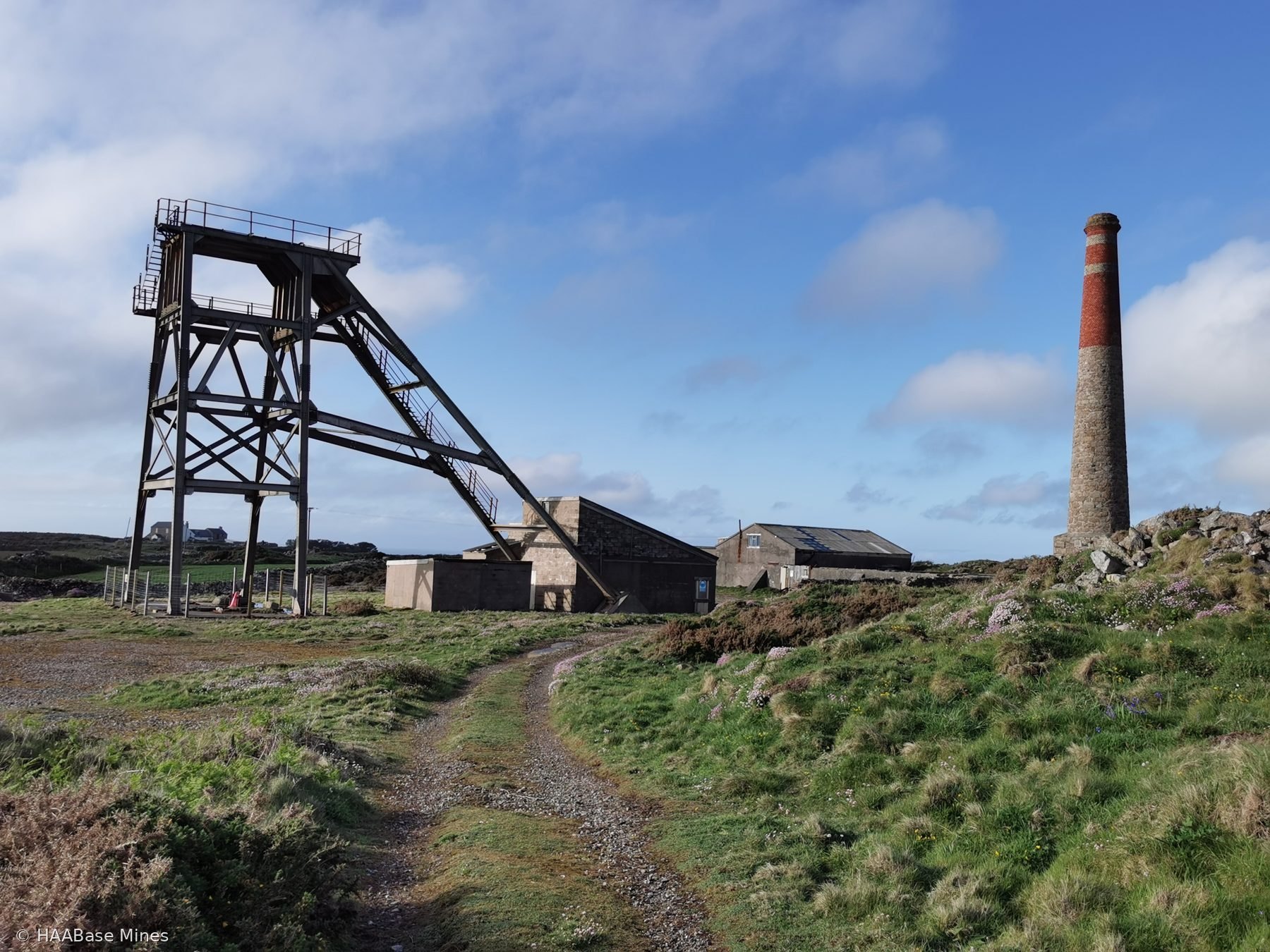
The exposed cliffs around Botallack, between St Just and Pendeen, belong to a mining landscape shaped by generations of tin and copper extraction. The mineral-bearing lodes extend from the granite and adjoining rocks out under the Atlantic, creating unusual demands on drainage, transport and the safety of those working underground. Archaeological evidence has been interpreted as suggesting mining around the Roman period, with possible earlier prehistoric activity, but the securely documented history begins by the sixteenth century. A copper-mining reference to the Cudnareeve workings at Botallack dates from 1587; the Elizabethan writer John Norden described a coastal hamlet busy with tinners around 1590. Early shafts were relatively shallow because pumping water from deeper workings was difficult.
During the eighteenth century successive workings became linked into a broader mining concern. A deep adit was driven towards the Corpus Christi Lode, while the Crowns, Wheal Cock and other coastal workings explored mineral deposits extending below the seabed. By 1774 miners were already working under the sea at Tolvan shaft, an indication of the advances in pumping machinery which made such exploration practicable. Over time the Botallack group also embraced workings inland, including Carnyorth and Parknoweth. The history of these component mines is part of the development of Botallack as a large mining undertaking, although their individual shafts and engine houses were not all at the surviving Crowns complex.
The Crowns lie on rocky ground beneath the main cliff. The lower engine house was erected in 1835 to contain a 30-inch pumping engine made by Harvey’s of Hayle, drawing water from Engine Shaft. Its granite walls, surviving chimney fabric and the remains of the adjoining boiler house show the arrangements needed to operate a Cornish pumping engine in a particularly exposed situation. The upper engine house dates to about 1862. It housed Pearce’s 24-inch winding or whim engine for the Boscawen diagonal shaft, which took wheeled conveyances along an inclined route into the workings. The associated boiler-house walls and the route of the flue up the slope can still be traced. These two buildings served different functions and different shafts, rather than forming a single engine installation of one date.
Botallack was placed on the market in 1835. Stephen Harvey James, a local man remembered as a former Cornish wrestler, became closely associated with its management and survival during years of falling tin prices and financial difficulty. In around 1841–42 a major discovery of copper on Crowns Lode transformed its prospects. Accounts differ slightly over the exact discovery year: the National Trust uses 1841, while the Cornish Mining World Heritage Site guide records a rich discovery in 1842, followed by production between 1842 and 1845 which returned a reported profit of £44,000. The copper lode yielded spectacularly for a time but was uneven, and later profits depended strongly on tin from inland portions of the mine. At its height the company employed more than 550 people, including some 340 men underground.
The expansion of nineteenth-century mining brought offices and management accommodation as well as pumping and winding engines. Botallack’s substantial Count House was completed around 1861–62, built of local stone as a deliberately imposing residence and office for the mine captain, purser and other staff. The building was the setting for accounting and the payment of miners. Some worked by tutwork, paid according to the amount of excavation completed, while others worked on tribute in gangs and shared the risks of searching for productive ore. Tribute workers also bore charges for such necessities as candles, explosives and the handling of waste. The arrangements illustrate the different financial risks faced by mine owners and miners, even at a prosperous mine. The Count House itself survives and is separately Grade II listed.
The Boscawen diagonal shaft was one of Botallack’s most ambitious engineering undertakings. Its development in the late 1850s and early 1860s provided an inclined route from the cliffs into the submarine workings; the National Trust describes a shaft running 664 metres beneath the sea. Pearce’s winding engine in the upper Crowns house was integral to this system. In 1863 a chain failed on a conveyance travelling in the shaft, sending it down the incline and killing eight men and a boy. The disaster illustrates the risks attached to the movement of people underground in an industrial landscape otherwise celebrated for its technological achievement.
Botallack also attracted visitors. In 1850 the writer Wilkie Collins visited and later described entering the underground workings in his travel book Rambles Beyond Railways. In 1865 the Prince and Princess of Wales descended the Boscawen shaft, drawing still more attention to the mine. It subsequently charged visitors a guinea to experience the underground workings. Such tourism, striking in a mine where working conditions remained physically severe, became one more distinctive part of Botallack’s nineteenth-century reputation.
Mining and processing left substantial remains beyond the Crowns. Steam-powered winding and pumping machinery served numerous workings, and the ore extracted from the lodes required stamping, separation and treatment. Tin concentrates were roasted to remove arsenical impurities; the poisonous fumes were led through long condensing passages where arsenic could be recovered. Surviving parts of the arsenic labyrinth, chimneys and dressing floors make it possible to understand the connected operations of extraction and processing. Published National Trust totals for Botallack are approximately 14,500 tonnes of tin, 20,000 tonnes of copper ore and 1,500 tonnes of refined arsenic. These are different categories of product, and the copper figure refers to ore rather than an equivalent quantity of pure metal. Tin and copper dominated its economic history, but the local deposits also contained cobalt, lead, iron, silver and the copper mineral botallackite, named from its discovery here.
As the nineteenth century advanced, the mine faced difficult ore conditions, competition from overseas tin and the high cost of pumping water from deep submarine workings. By 1895 low tin prices and the cost of keeping the shafts drained forced closure. The abandonment of the mine left engines, buildings, winding equipment and dressing floors scattered across its extensive sett, while the coastal landscape continued to carry the marks of centuries of industry.
An ambitious revival followed in the early twentieth century. The new programme included Allen’s Shaft, a large steam hoist, compressor equipment and an electric power station, alongside substantial changes to the dressing floors. The 1906 tin mill contained concrete supports for a battery of Californian stamps, shaking tables, Frue vanners, buddles and a Brunton calciner. The physical remains of these installations are an important part of Botallack’s story, distinct from the older Crowns houses further out on the cliff. The attempt proved short-lived: despite the heavy investment, the operation ceased in March 1914, shortly before the beginning of the First World War.
There were later suggestions of recovering minerals from Botallack. Geevor Tin Mine investigated reopening the workings in the 1980s, but the dramatic collapse in the international price of tin in 1985 undermined the possibility. Conservation of the standing ruins nevertheless gained momentum. The Carn Brea Mining Society repaired the Crowns engine houses in 1985, and the National Trust acquired Botallack Mine and the Crowns in 1997. The lower and upper houses had been Grade II listed in 1979, and the Count House had received its own Grade II designation in 1973. Their original granite masonry is now retained as conserved roofless industrial fabric, rather than restored to working condition.
In 2006 Botallack became part of the Cornwall and West Devon Mining Landscape UNESCO World Heritage Site, within the St Just Mining District. Today the Count House and associated visitor facilities provide an introduction to the wider industrial landscape, while the coast path passes the remains of shafts, engine houses, chimneys and the arsenic labyrinth. Other nearby mines, including Wheal Owles and Wheal Edward, remain distinct historic workings within the same coastal district. Against the sea and cliffs, the Crowns survive as a visible reminder of the ingenuity, labour, danger and extraordinary scale of Cornish submarine mining.
This list includes live sources already held for the record and any additional sources added or confirmed during the published fact-check review.